How to Secure your Smartphone and Increase Your Mobile Security
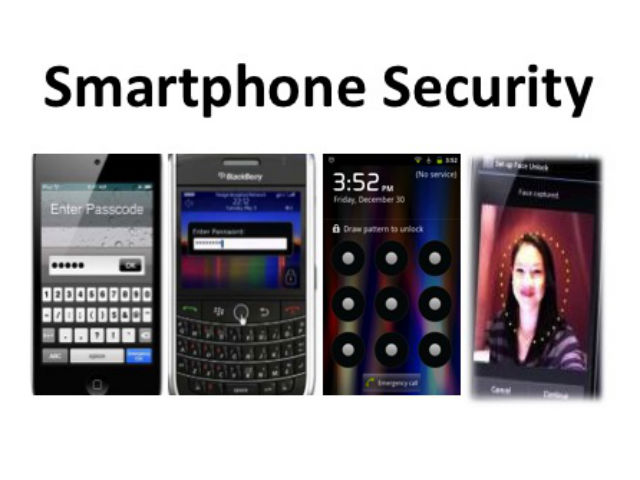
As smartphones increase in popularity, threats to privacy grow too. We enjoy the convenience of using our phones for online banking, shopping, email, social media, web browsing, storage of personal information and keeping track of our schedules however these conveniences make us vulnerable if our devices are accessed by others. Losing or having our phones stolen or even inadvertently giving others temporary access to our phone subjects us to potential serious personal and financial risks.
Here are six ways to increase your mobile phone safety and to keep your smartphones secure:
1. Use a Password, Personal Identification Number (PIN), Biometric or Pattern to unlock your phone
It can be a nuisance entering a code each time you want to use your phone but it’s well worth it if you consider the inconvenience you’ll incur if a thief accesses your private information
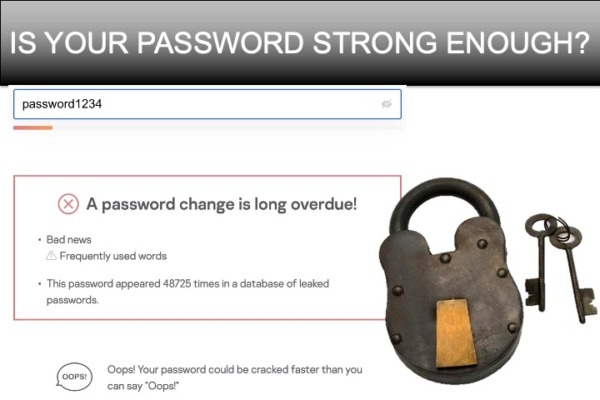
- Use a long password or PIN because those that are 8 or more characters in length are harder to crack and more secure. For general passwords tips, read article regarding Keeping Track of Passwords
- My son accesses his HTC One smartphone with facial recognition that works reliably for him. We tried to fool the phone by using several photographs and were pleased to see they didn’t unlock his phone
- My phone has a pattern option which I don’t care for. But that doesn’t mean it won’t work well for you
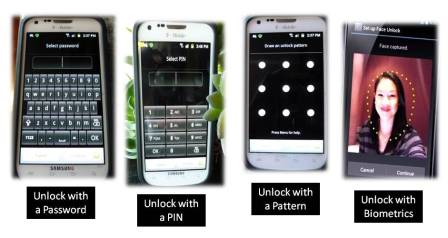
There are multiple ways to unlock a smartphone
2. Use virus protection on your phone (just as you should on your computer)
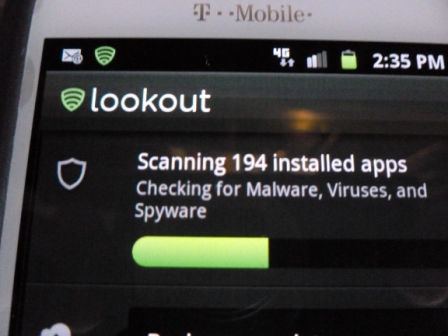
“Lookout” scans for malware
- I use “Lookout” on my Samsung Galaxy which was recommended to me by T-Mobile. Ask your service provider for suggestions if you need to
- I was surprised to see I have 194 installed apps – I only use a handful of them and plan to remove the ones I don’t use
3. Make sure apps are safe before you install them on your phone
Apps are used for all sorts of conveniences including online banking, controlling your home temperature or even keeping a remote eye on your home via a video feed. Only install apps from trusted sources. Installing apps from Marketplace reduces your risk and increases phone safety because all apps on marketplace are digitally signed. Similarly, buy apps for the iPhone from Apple’s App store.
4. Install updates for your phone
Updates often include security patches. Install updates for your phone and for apps when you are notified they are available. If you don’t know how to do this, contact your service provider for guidance
5. Make sure your phone has a feature that allows you to wipe the data clean if it is stolen and to help you find it if you lose it
- My Samsung Galaxy smartphone has a feature to find it even if the phone has no battery power
- In addition to features for lost phone location, some smartphones allow you to lock them and to wipe them clean remotely so no one can gain access to the stored information. I know someone that recently wiped his iPhone 5 clean remotely rather than trying to locate it because he did not want anyone to access his stored information. It was easier to handle the loss of the costly device than the loss of privacy, money and time that could result from someone using his information
- If your phone does not include these features, search for an application you can install
6. Turn off location services (GPS) when not in use so that others can’t track your every move.
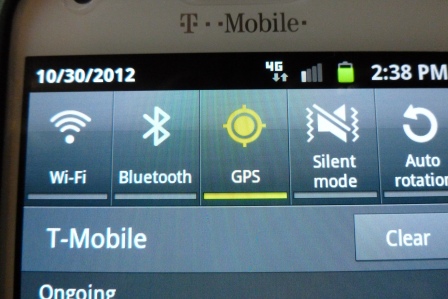
GPS on when green
We can use privacy settings to prevent being “Checked in” via Social Media, however smartphones can allow others to track us when we’d prefer they don’t. I simply turn off my GPS whenever I am not using navigation and I usually choose not to use Social Media to check into places in addition to preventing others to do that on my behalf. Again, reference your user manual or contact your service provider if you need assistance disabling tracking
If you have additional safety tips for using smartphones, I’d love to hear them. Please share in a comment following this article.
Until next time,… Stay Cyber Safe!